
Traditional marketing reporting answered the question "what did marketing do?" Revenue intelligence answers the question the CEO was asking the whole time: "what did marketing earn?" That shift, from activity to income, is why the monthly deck of impressions and click rates is vanishing from board meetings, and why revenue operations teams now sit at the center of go-to-market planning.
What Is Revenue Intelligence
Revenue intelligence is the practice of connecting every marketing and sales touchpoint to closed revenue, then using that connected record to plan spend and forecast outcomes. It borrows the discipline of business intelligence and applies it to one specific question: which activities produce paying customers, and at what cost.
Where marketing analytics tracked campaign performance in isolation (this ad got 400 clicks, this email got a 31% open rate), revenue intelligence follows those clicks through the pipeline to the deals they became. The unit of measurement changes from the click to the dollar.
The category grew out of the sales side first. Platforms like Gong and Clari built sales intelligence products around call recordings and deal signals. Marketing teams had their own stack of ad dashboards and web analytics. Revenue intelligence merges the two views into one funnel, from the first anonymous website visit to the signed contract and the renewal after it.
Why Traditional Marketing Reporting Stopped Working
Marketing performance used to be graded on proxies. A lead counted the same whether it closed in 30 days or never. A campaign could look excellent in the marketing dashboard while contributing nothing to revenue growth. Finance noticed, and marketing budgets got harder to defend every year.
The second failure was fragmentation. Sales data lived in the CRM, email data lived in the automation platform, spend lived in the ad accounts, and traffic lived in the web analytics property. Nobody owned the joins between them, so every "full-funnel report" was a manual export project that was outdated the day it shipped.
And the reports only described the past. By the time a quarterly readout was assembled, next quarter's budget was already committed. Reporting told you what happened. It never told you what to do.
How Revenue Intelligence Works
One data layer from first touch to closed deal
The mechanics are less exotic than the name suggests. Every contact gets a record in the CRM. Campaign identifiers travel with that record through every stage. When a deal closes, the revenue posts back to the channels and campaigns that sourced and influenced it. That single connected layer is what makes pipeline analytics possible: you can see how many open opportunities each channel created, how fast they move, and where they stall.
This is not an enterprise-only project. Customer relationship management for small business can be a free HubSpot account plus disciplined UTM tagging. The tooling matters far less than the connection between marketing records and closed deals.
Revenue Forecasting and Predictive Intelligence
Once historical funnel data sits in one place, revenue forecasting stops being a sales manager's gut call. You can project next quarter from current pipeline volume and historical conversion rates by stage. Predictive intelligence goes a step further, scoring leads and open deals against the behavior patterns that preceded past wins, so marketing operations can shift budget mid-quarter instead of reading about the miss in April.
Forecasts built this way are also inspectable. When the number moves, you can trace the movement to a specific stage, segment, or channel and act on it.
Benefits of Revenue Intelligence
Sales and marketing alignment
The oldest argument in B2B is sales blaming lead quality while marketing points at lead volume. Revenue intelligence ends the argument by putting both teams on the same scoreboard. When marketing-sourced pipeline and its close rate are visible to everyone, the conversation moves from blame to allocation. Sales and marketing alignment stops being an offsite topic and becomes a shared dashboard.
Marketing ROI you can defend to a CFO
Marketing ROI becomes an arithmetic problem with revenue in the numerator. Cost per closed customer by channel. Payback period by campaign. Marketing effectiveness gets measured in the same currency as everything else the CFO reviews, which is the only way a budget survives a hard year.
Marketing Reporting Best Practices Under a Revenue Model
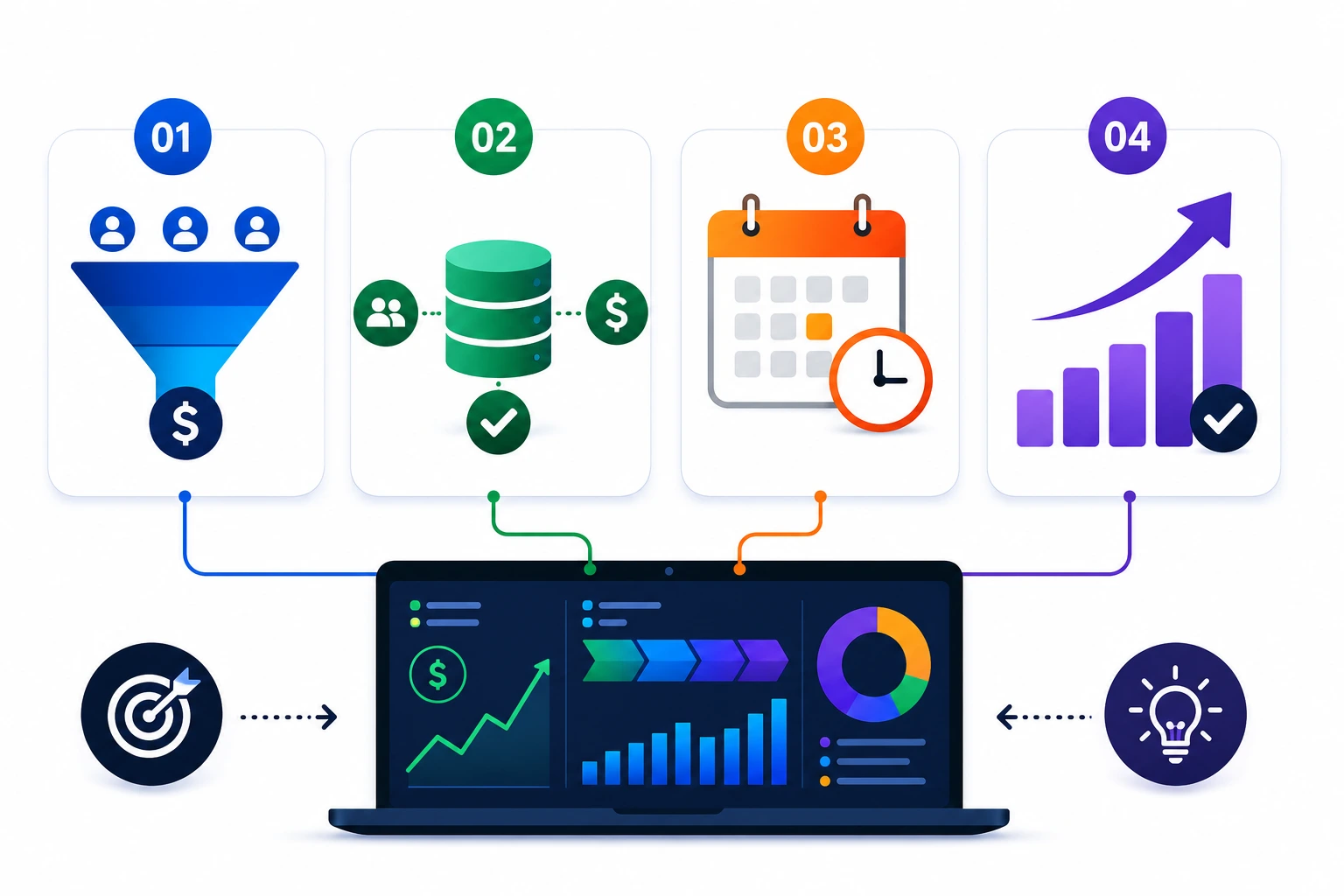
Marketing reporting best practices used to mean a tidy monthly deck. Under a revenue model, the standard is different. Four rules cover most of it:
- 1. Report revenue and pipeline first, activity metrics second, if at all.
- 2. Use one shared data source for sales and marketing, with agreed definitions for every stage.
- 3. Report on a cadence that allows correction (weekly pipeline reviews beat quarterly retrospectives).
- 4. Pair every number with a decision. A metric nobody acts on should leave the report.
Where the Tactical Services Fit
Revenue data changes how you buy tactics, too. Conversion optimization services get pointed at the pages feeding high-value pipeline instead of the pages with the most raw traffic. Landing page optimization services get judged on cost per qualified opportunity rather than form fills. Advertising strategy shifts budget toward the audiences that produce customers who stay past month three. Even organic search performance gets a revenue lens: a keyword that ranks fourth and sources pipeline beats one that ranks first and sources nothing.
How to Increase Customer Lifetime Value with Revenue Data
Anyone asking how to increase customer lifetime value should start with acquisition source. Customers from different channels retain and expand at different rates, and a connected revenue view exposes those differences immediately. From there, the practical strategies to increase customer lifetime value are straightforward: spend more on the sources that produce durable customers, build onboarding around the behaviors your longest-tenured accounts showed early, and time expansion offers to usage signals rather than the calendar. Retention work funded by acquisition data usually beats retention work funded by instinct.
Lifetime value is also the number that makes the whole system pay for itself. When you know what a customer from a given channel is worth over three years, you know exactly how much you can afford to acquire the next one.
The Bottom Line
Marketing reporting described activity. Revenue intelligence prices it. Teams that make the switch argue less, forecast better, and spend their next dollar where the last one earned the most. The deck of impressions had a good run. It earned retirement.

